
Peptide Reconstitution Maths: Calculating Concentration and Reconstitution Volumes
Key takeaways
- Why reconstitution maths matters
- The core formula
- Working backwards from a target concentration
- Converting to molar units
Why reconstitution maths matters
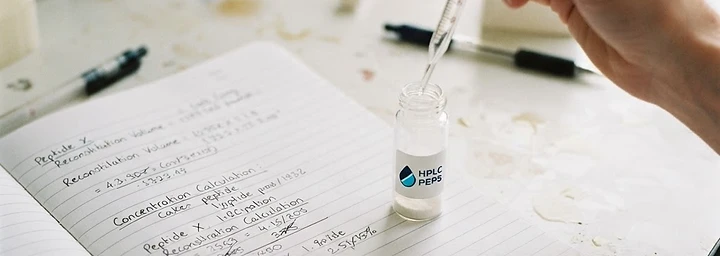
Lyophilised research peptides arrive as a precise mass of freeze-dried powder inside a sealed vial. Before any in vitro or laboratory work can begin, that powder must be dissolved in a measured volume of solvent. The concentration of the resulting solution is not printed on the vial — it is a function of two numbers you control: the mass of peptide in the vial and the volume of solvent you add.
Getting this calculation right is the difference between a reproducible experiment and an uncontrolled variable. This guide walks through the maths step by step.
The core formula
Concentration is mass divided by volume:
Concentration (mg/mL) = Peptide mass (mg) ÷ Solvent volume (mL)
A 5 mg vial reconstituted with 2 mL of bacteriostatic water yields a 2.5 mg/mL solution. The same 5 mg reconstituted with 1 mL yields a 5 mg/mL solution. The peptide mass is fixed by the manufacturer; the researcher controls the final concentration through the diluent volume.
Working backwards from a target concentration
Researchers often start with a desired concentration and need to calculate the solvent volume:
Solvent volume (mL) = Peptide mass (mg) ÷ Target concentration (mg/mL)
To obtain a 1 mg/mL solution from a 10 mg vial, add 10 mL of solvent. To obtain a 2 mg/mL solution from the same vial, add 5 mL.
Converting to molar units
Many laboratory protocols specify concentration in micromolar (µM). To convert:
- Divide the mass in milligrams by 1000 to get grams.
- Divide by the molecular weight (g/mol) to get moles.
- Divide by the volume in litres to get molarity.
- Multiply by 1,000,000 to express as micromolar.
For a 5 mg vial of a peptide with a molecular weight of 1,500 g/mol reconstituted in 2 mL: 0.005 g ÷ 1,500 = 3.33 × 10⁻⁶ mol, divided by 0.002 L = 1.67 × 10⁻³ M, or roughly 1,670 µM.
Common errors
- Confusing total mass with concentration. A "10 mg vial" describes the peptide mass, not the concentration. Concentration only exists once solvent is added.
- Ignoring the vial's fill volume. Some vials contain fillers or appear partially full; the stated mass is what matters, not the visible powder volume.
- Failing to account for the dead volume. A small amount of solution cannot be recovered from the vial; account for roughly 0.05–0.1 mL of unrecoverable liquid when planning volumes.
Practical workflow
- Read the COA to confirm the exact net peptide mass in the vial.
- Decide your target concentration based on your protocol.
- Calculate the solvent volume required.
- Draw the solvent into a syringe, inject it gently against the vial wall (not directly onto the powder), and swirl — do not shake.
- Allow the solution to stand until fully clear, confirming complete dissolution.
Accurate reconstitution maths is the foundation of reproducible peptide research. Every downstream result depends on the concentration being exactly what you calculated.
UK Locations Mentioned in This Article
From the locations referenced above to laboratories nationwide — HPLC Peps delivers research peptides across Britain.

Related Research Compounds
Lab-verified, 99%+ purity compounds relevant to this research — each with a published Certificate of Analysis.


Research-grade peptides for your laboratory
Browse the shop